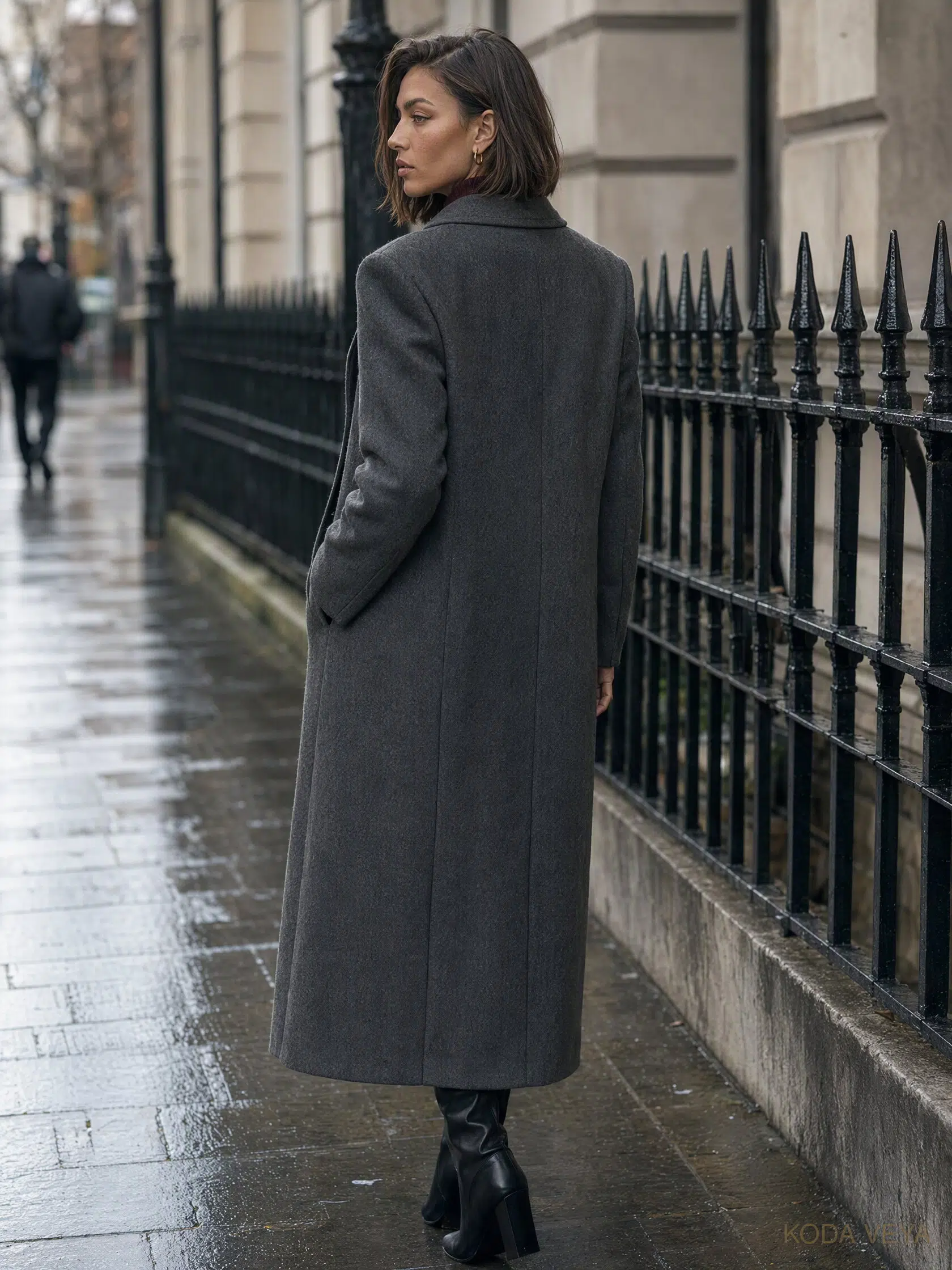
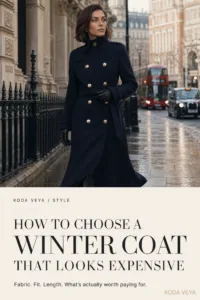
Get the look: Lauren Ralph Lauren Double-Breasted Belted Funnelneck Coat — £485. Shop the coat →
Style / The Koda View
How to Choose a Winter Coat That Looks Expensive
A winter coat is the first thing anyone sees for months. What makes one look expensive, and what the extra money actually buys.
A note on links. Some links in this piece are affiliate links. If you buy through them, Koda Veya may earn a small commission at no extra cost to you. As an Amazon Associate, Koda Veya earns from qualifying purchases. How Koda chooses →
There are purchases you can hide.
A slightly disappointing T-shirt can disappear beneath a jacket. Shoes can be changed. A questionable knit gets forgiven the moment you put something better over it.
A winter coat gets no such protection.
For several months of the year, it is the first thing anyone sees. Sometimes it is practically the only part of the outfit they see. You can have the perfect trousers underneath and nobody on the Victoria line is going to know.
Which is why I think a good coat deserves more scrutiny than almost anything else in a winter wardrobe.
Not because it needs to be expensive.
Because it needs to look considered.
The Coat Decides the Outfit
We’ve become very good at talking about investment pieces while being remarkably vague about what makes something worth investing in.
Price isn’t enough. Neither is a designer label. And “timeless” has been used to describe so many beige things that it has almost stopped meaning anything.
A good winter coat does something more practical: it gives the rest of your wardrobe structure.
Throw it over jeans and a knit and the outfit looks finished. Wear it over something more deliberate and it doesn’t compete. Leave it open and the line still works.
That is what I’m looking for.
Not a coat that requires styling.
A coat that does some of the styling for you.
02Start With the Fabric
This is where I’d look before checking the label on the neck.
Turn the coat over and find the composition label.
For a classic tailored winter coat, I generally want wool to be doing a meaningful amount of the work. Wool insulates without needing enormous bulk and gives a coat the sort of body that helps a clean silhouette hold its shape.
But I wouldn’t obsess over an arbitrary percentage.
An excellent wool blend can be preferable to a disappointing coat simply because another one has a higher number printed on its label. Weight, density, finish and construction matter too.
What I’m more suspicious of is a coat with a luxury price and a composition dominated by inexpensive synthetic fibres without an obvious performance reason.
Polyester isn’t automatically bad. Nor is nylon. Both can have legitimate uses for durability, weather resistance and technical outerwear.
The question is whether the fabric makes sense for the coat you’re buying.
A £700 tailored overcoat made largely from acrylic needs to have a very persuasive explanation.
03Feel the Fabric Properly
Online shopping has made us strangely comfortable buying clothes without touching them.
Coats are one of the pieces where that matters.
A good wool coating fabric should usually feel substantial rather than papery. Scrunch a little of it gently in your hand. Look at how quickly it recovers. Run your fingers across the surface and notice whether it already looks excessively fuzzy.
Some beautiful fabrics have a deliberately brushed finish, so this isn’t about rejecting softness. It’s about distinguishing intentional texture from a surface that looks tired before you’ve even taken it outside.
The expensive-looking coat tends to have density.
It hangs instead of flapping.
04Then Look at the Shoulder
This is where a great deal of otherwise perfectly good outerwear goes wrong.
The shoulder establishes the architecture of the coat.
On a traditionally tailored shape, it should look deliberate: neither collapsing beyond your frame nor pulling tightly across it.
An oversized coat is different. The shoulder may intentionally drop several centimetres down the arm. But intentional oversizing still has shape.
There is a difference between oversized and too big.
One looks designed.
The other looks borrowed.
I’d pay particular attention to the coat from behind. If the collar lifts away from the neck, the upper back pools strangely or you can see strong horizontal pulling across the shoulder blades, try another size or another cut.
No amount of cashmere content is going to repair a silhouette that fights your body.
05Try It With Actual Winter Clothes
This sounds obvious, yet coat shopping in September has fooled many of us.
You’re wearing a T-shirt. The shop is warm. The coat falls beautifully.
November arrives.
You put a proper jumper underneath and suddenly your arms can’t move.
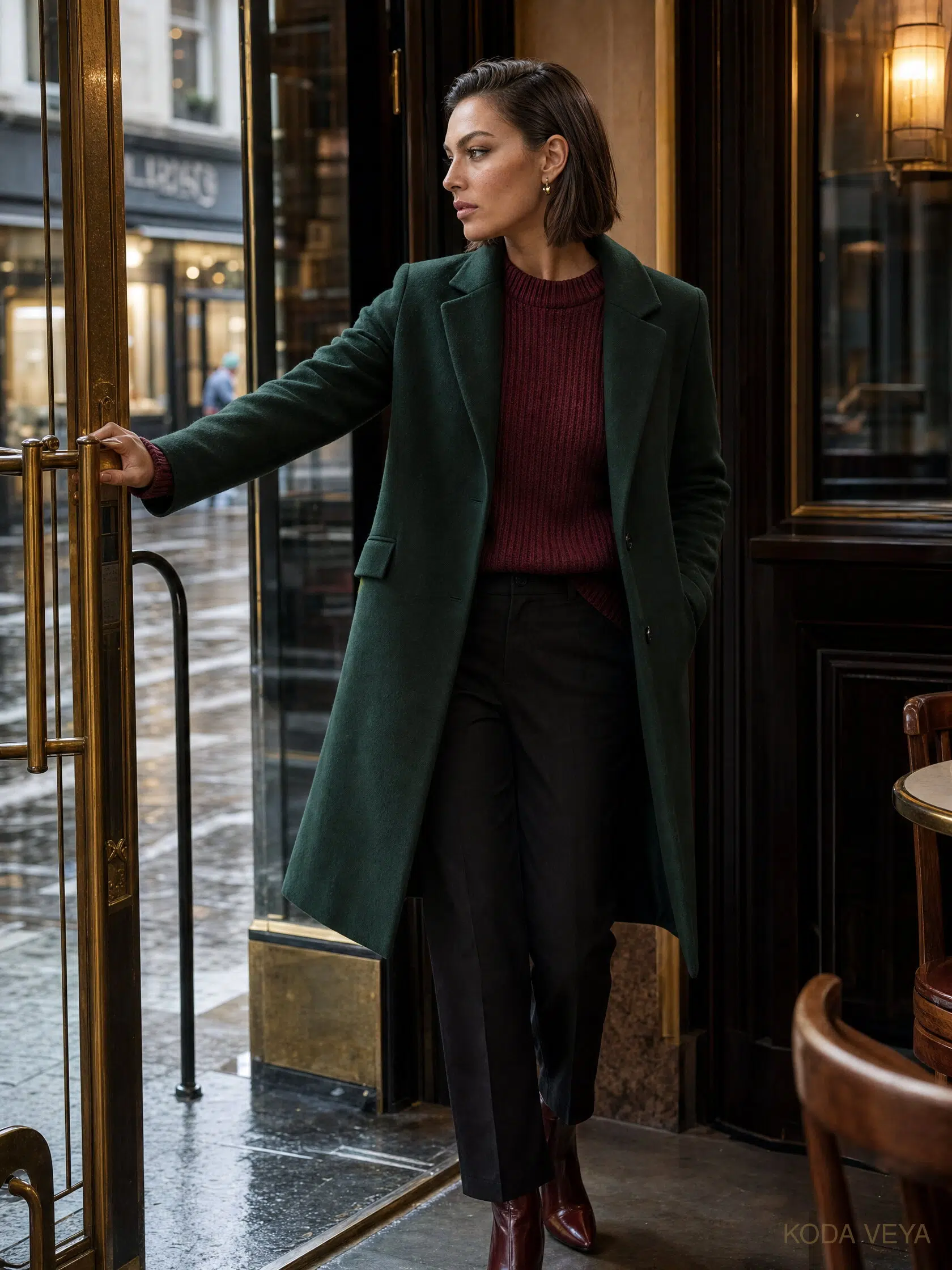
Try a winter coat with the sort of clothes you will actually wear beneath it. A chunky knit. A blazer. Whatever represents your normal cold-weather layers.
Button it.
Put your arms forward.
Sit down.
Put your hands in the pockets.
If the entire coat rises when you move your arms, the back strains when you sit or the buttons look as though they’re negotiating their escape, the fit isn’t right.
I’m not interested in owning clothes that work exclusively while standing beautifully still.
06Length Changes Everything
If you’re buying one serious winter coat, I’d usually go longer rather than shorter.
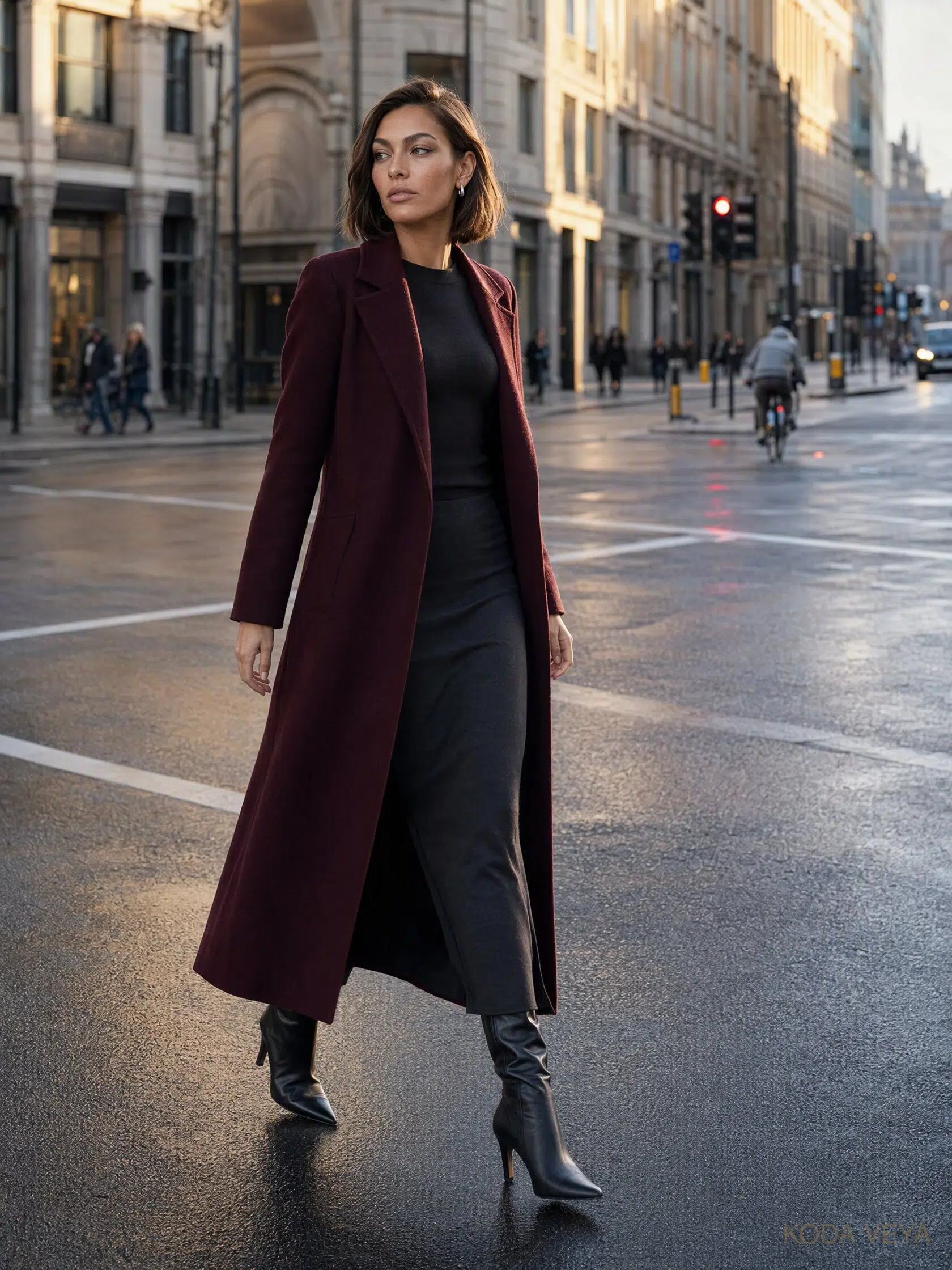
Somewhere around the knee or below gives you considerably more visual impact and more actual coverage. It also creates one uninterrupted vertical line, which is one reason a relatively simple long coat can make inexpensive clothes beneath it look much more polished.
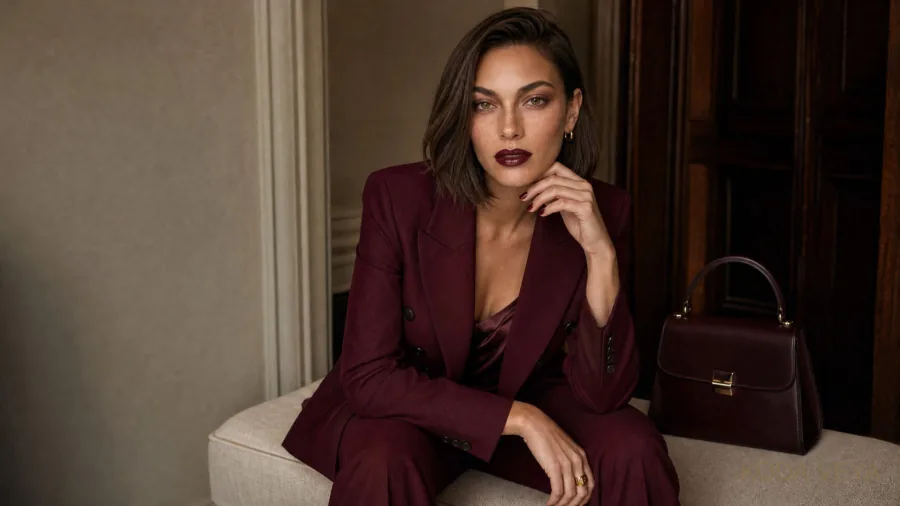
Shop similar: Long burgundy coat — Amazon →
That doesn’t mean everyone needs a floor-skimming maxi.
Proportion matters.
A long coat should move with you rather than overwhelm you. If there is so much fabric that you’re constantly gathering it on stairs, sitting on it or trying to stop it entering puddles, sophistication has lost the argument to logistics.
The right length is the longest one you can wear without becoming its full-time carer.
07Single-Breasted or Double-Breasted?
I don’t think one is inherently more expensive-looking.
They simply do different things.
A single-breasted coat gives you a cleaner uninterrupted front and is particularly easy to wear open. It tends to disappear into an outfit slightly more, which can make it enormously useful.
Double-breasted coats have more presence. The overlapping front, buttons and stronger tailoring can create a wonderfully architectural shape.
But this is also where cheap hardware becomes very obvious.
Eight shiny plastic buttons can undo several metres of beautiful wool remarkably quickly.
If the coat is otherwise excellent, replacing buttons is one of the few small alterations I genuinely think can transform the whole thing.
08The Lining Tells You Something
Look inside.
Not because every expensive coat needs a luxurious lining, but because the interior often reveals how much thought went into the garment.
Check whether the lining sits smoothly. Look around the armholes. Inspect the seams. See whether loose threads are already appearing.
Viscose, cupro and acetate linings can feel particularly pleasant over knitwear and tailoring, but polyester lining isn’t an automatic rejection. What matters is that it feels comfortable, moves properly and isn’t fighting the outer fabric.
And some double-faced wool coats deliberately have very little traditional lining at all.
Again: construction before rules.
09Details Shouldn’t Be Trying Too Hard
There is a particular category of coat that wants you to know how expensive it was.
Enormous gold buttons. Excessive buckles. Branded hardware. Decorative straps whose precise function remains mysterious.
Sometimes that’s the point, and fashion is allowed to have fun.
But if the goal is a coat that looks expensive for several winters rather than spectacular for six weeks, restraint usually wins.
I look for lapels with enough substance to sit properly, pockets positioned where they don’t distort the hip, buttons that suit the fabric, and seams that remain flat.
Then I look at the back.
A clean back view is underrated.
10Camel Isn’t Your Only Option
The expensive-looking winter coat has somehow become synonymous with camel.
Camel is beautiful.
It is not compulsory.
Deep navy can look exceptionally sophisticated and is easier with black than people pretend. Chocolate brown has warmth without feeling predictable. Charcoal works particularly well with sharper tailoring. Burgundy can function almost like a neutral in winter.
Black, done properly, is still difficult to beat.
The useful question isn’t “Which colour is timeless?”
It is:
Which colour works with the clothes I actually own?
A perfect cream coat that spends winter avoiding coffee, public transport and weather is not an investment.
It’s a hostage situation.
11What I’d Spend More On
I’d spend for fabric.
I’d spend for shape.
I’d spend for enough length and weight that the coat hangs beautifully.
And I’d spend for a cut I can realistically wear several times a week.
I wouldn’t automatically spend more for a conspicuous logo, decorative hardware or a colour that works with precisely one outfit I’ve imagined while standing in the changing room.
The arithmetic of an expensive coat becomes surprisingly reasonable if you genuinely wear it.
A £300 coat worn 100 times costs £3 per wear.
A £90 coat you never quite like enough to reach for is considerably more expensive in the only calculation that matters.
12Koda’s Edit: Four Wool Coats Worth Comparing
If you’re looking for a wool coat now, I’d start by ignoring the label on the neck and comparing what the extra money actually buys you.
At £150, the M&S Autograph Wool Blend Longline Tailored Coat is the baseline. It has the long, uncomplicated shape I’m talking about throughout this piece: a single button, no theatrical hardware, no unnecessary detailing, just a coat that needs to get the proportion right.
Move to ARKET at £259, and I expect more from the cloth and the finish. The ARKET Wool-Blend Coat is a clean, regular-fit black coat: the same simple idea as the M&S, for over £100 more. That’s exactly why it’s a useful comparison. If you can’t see the difference, you don’t need to pay for it.
For roughly the same money, the COS Shawl-Collar Double-Faced Wool Long Coat at £249 offers a completely different proposition. It’s softer, longer and less conventionally tailored. That’s useful because spending more shouldn’t simply mean buying the same coat with a nicer label. Sometimes it should buy you a shape you couldn’t find at the first price point.
Then there’s the COS Tailored Wool-Zibeline Long Coat at £499.
This is where I’d become difficult.
For almost £500, I want to see the money. Here, at least, there is something to examine: 100% wool, a richer zibeline cloth, full lining and a more considered rounded construction.
Is that automatically worth twice the price of the £249 COS coat?
No.
Put both over a black knit and trousers. Leave them open. Look at them from the side and from behind.
If the £499 coat doesn’t make you understand where the extra £250 went, buy the £249 one.
That is the entire point of the exercise.
Koda’s Edit — At a Glance
| Coat |
Material & Texture |
Fit & Silhouette |
Best For |
M&S Autograph Wool Blend Longline Tailored Coat
£150 |
52% wool blend; soft handle, fully lined |
Tailored fit, longline, single button, balloon sleeves |
The baseline: a clean, everyday long line |
ARKET Wool-Blend Coat
£259 |
Wool-blend coating; cleaner, more refined finish |
Regular fit, long and minimal |
The step up: understated everyday polish |
COS Shawl-Collar Double-Faced Wool
£249 |
Double-faced wool blend; softer, more fluid handle |
Long regular fit, shawl collar, detachable belt |
The different shape: relaxed, elegant layering |
COS Tailored Wool-Zibeline
£499 |
100% RWS wool; tactile Italian zibeline, fully lined |
Rounded regular fit, high stand collar, concealed buttons |
The fabric upgrade: when construction and cloth matter most |
13Before You Buy It
Ignore the styling around it for a moment.
Ignore the boots, the beautiful model and the perfectly tonal knit underneath.
Look at the coat.
Would it work with denim?
Would it work over evening clothes?
Can you fit February underneath it?
Does the shoulder still look good from behind?
Would you want to wear it three days in a row?
And most importantly, does it improve the clothes you already own?
Because that is what a genuinely good coat does.
It doesn’t require a new winter wardrobe to justify itself.
It makes your existing one look better.
Further reading
What Makes an Outfit Look Expensive →
The Art of Looking Effortless →
Quiet Luxury, Without the Performance →
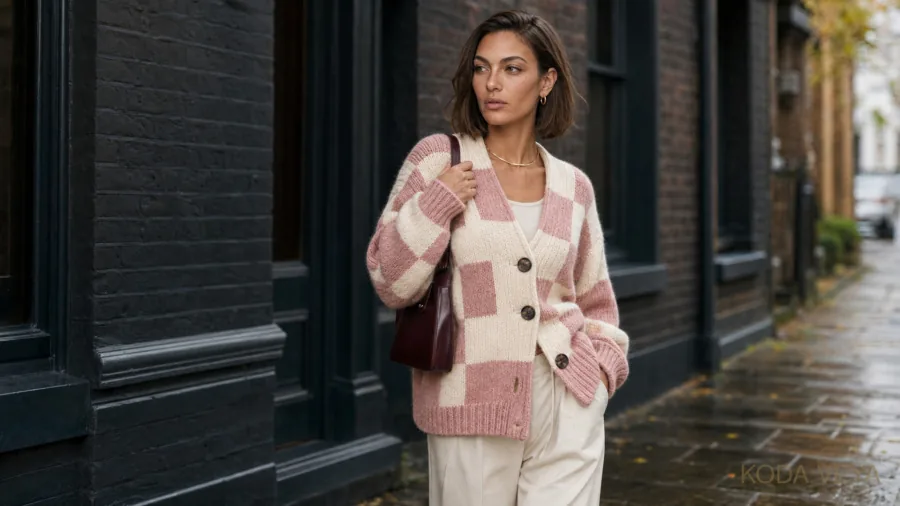
How to Wear a Checkered Cardigan →
 Save for later
Join the Edit · Free guide
The Koda Wardrobe Edit
A free guide to buying better, wearing more and editing out the noise.
- Work out what you actually wear, and why
- The colour ratio method
- A one-page wardrobe brief to keep for your next purchase
Sent straight to your inbox, along with my latest fashion, beauty and wellbeing edits. Unsubscribe any time.